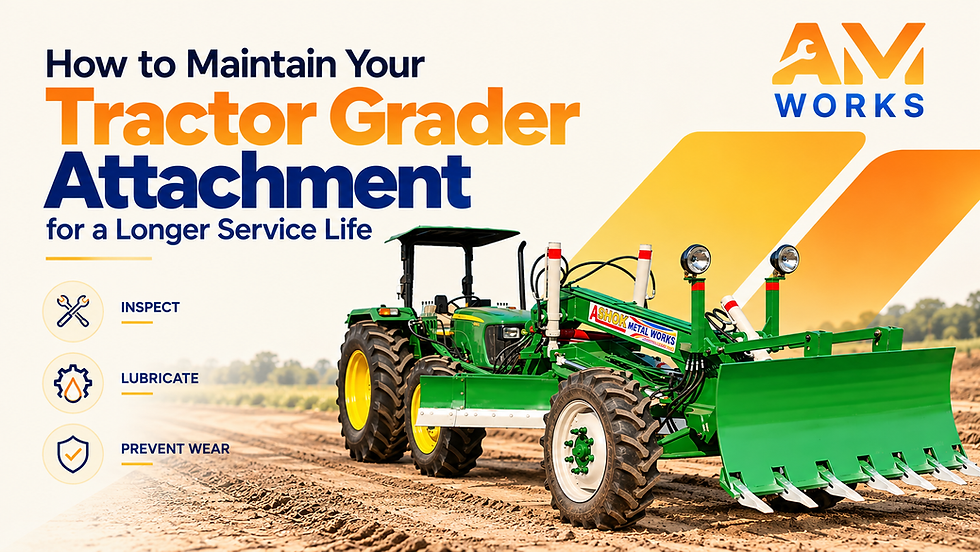
How to Grade a Road Properly: Step-by-Step Guide for Contractors Using Tractor Graders

Road grading is one of the most skill-dependent tasks in rural construction. Done correctly, it produces a durable, well-drained road surface that lasts through monsoons, heavy loads, and daily traffic. Done incorrectly, it leads to waterlogging, rutting, and premature failure at high cost to contractors and project owners.
If you want to know how to grade a road with tractor grader equipment effectively, this guide covers the complete process from pre-grading site assessment to final finish passes and explains how the right tractor grader attachment setup directly determines the quality of the output. All technical references in this blog are based on verified specifications from Ashok Metal Works (AMW) grader products.
🛠️ What is Road Grading and Why Does It Matter?
Grading is the process of reshaping the road surface and its cross-section to achieve a precise, even profile. It involves cutting high spots, filling low spots, shaping the camber (the crown of the road for water drainage), and preparing the sub-base for final surfacing.
In rural India across Madhya Pradesh, Uttar Pradesh, Chhattisgarh, Odisha, and Rajasthan a large portion of road construction and maintenance is carried out under government schemes such as PMGSY (Pradhan Mantri Gram Sadak Yojana) and MNREGS. Contractors working on these schemes require equipment that is cost-effective, compatible with standard tractors, and capable of delivering consistent grading output.
Tractor grader attachments from Ashok Metal Works (AMW) are purpose-built for exactly this context transforming standard 2WD and 4WD tractors into capable grading machines.
🚜 Choosing the Right AMW Grader for the Job
Before the first pass, selecting the correct grader model for your tractor and terrain type is critical. Ashok Metal Works (AMW) offers four grader variants. For contractor road grading work, the Single Pin and Double Pin Tractor Graders are the primary choices. For the first pass, selecting the correct grader model for your tractor and terrain type is critical. Ashok Metal Works (AMW) offers four grader variants. For contractor road grading work, the Single Pin and Double Pin Tractor Graders are the primary choices.
⚙️ Single Pin vs Double Pin — Quick Comparison

Feature | Single Pin Grader | Double Pin Grader |
Compatible HP | 49 – 110 HP | Above 49 HP |
Blade Length | 10 feet | 10 feet |
Blade Height | 18 inches | 18 inches |
Rotation Angle | ±45° | ±45° |
Tilt Range | 5° – 20° | 5° – 20° |
Camber Cutting | 5% | 5% |
Ground Clearance | 460mm | 460 mm |
Best Use | General road grading & leveling | Road levelling and grading using a 2WD tractor |
Warranty | 1-Year Hydraulic | 1-Year Hydraulic |
*Price disclaimer: Grader prices start from ₹4.15 lakh onwards. Final pricing depends on model and specifications. Contact AMW for a quote.
🛠️ Step-by-Step: How to Grade a Road with a Tractor Grader
Understanding how to grade a road with tractor grader attachments starts with following a disciplined, pass-by-pass process. The seven steps below apply to earthen and gravel rural roads, PMGSY project roads, and site levelling works across MP, UP, Chhattisgarh, and Odisha.
Step 1 — Site Survey and Marking
Before moving any equipment onto the road, conduct a proper site assessment:
• Walk the full stretch and note high and low spots, soft patches, and drainage flow direction.
• Mark the centre line of the road using stakes or chalk lines to maintain a consistent width.
• Identify the required camber slope typically 3–5% for rural roads. AMW graders support camber cutting up to 5%, consistent with standard road construction norms.
• Note the presence of buried utilities, culverts, or drainage channels that should not be disturbed.
Step 2 — Tractor and Grader Pre-Check
Equipment failure mid-pass compromises grading quality. Run through these checks before every job:
• Verify tractor HP is within the grader's compatible range. AMW Single Pin: 49–110 HP. AMW Double Pin: 49 HP and above.
• Check hydraulic oil levels and all hydraulic hose connections on the grader attachment.
• Inspect the cutting edge (150 mm width on Single Pin) for wear a worn edge reduces cutting precision and increases fuel consumption.
• Verify blade rotation and tilt are functioning freely across their full range (rotation ±45° on Single Pin, 30°–40° on Double Pin; tilt 5°–20° on both models).
• Ensure the tractor's rear tyres are properly inflated, and the grader is mounted securely with correct pin engagement.
Step 3 — First Pass: Rough Cutting
The first pass removes large irregularities and loosens the surface material. Set the grader blade at a moderate angle (approximately 30°–35°) to windrow material from the centre outward. For roads with significant crown collapse, start from the edges and work inward.
• Set blade tilt toward the direction of material displacement this prevents clogging under the blade.
• Travel speed: keep tractor in the lowest gear range for maximum blade control. Fast passes create wavy surfaces.
• Do not attempt deep cuts in a single pass. Multiple shallow passes produce better results than one aggressive cut.
• Windrowed material should be deposited consistently on one side to allow for redistribution in later passes.
Step 4 — Second Pass: Material Spreading and Profile Building
With the rough cut complete, use this pass to spread the windrowed material back across the road and begin building the cross-section profile.
• Reverse blade rotation slightly to move material from the windrow toward the centre.
• Use the blade tilt (5°–20° range) to direct material precisely upward. Tilt moves material up the blade face and spreads it wider; downward tilt concentrates the cut.
• Begin establishing the camber profile. AMW graders support 5% camber cutting height this means for every 10 feet of road width, the centre crown rises approximately 6 inches above the edge.
• Check cross-section regularly using a camber board or string line across the road width.
Step 5 — Shaping the Camber and Side Drains
Correct camber is the single most important factor in road longevity. A road without an adequate crown will collect water at the surface, leading to rapid deterioration.
• For gravel and earthen roads, target a 3%–5% camber. AMW graders are engineered for 5% camber cuttings suitable for both PMGSY specification roads and contractor-built rural access roads.
• Shape the side drains simultaneously so that,the graded material displaced from the road surface should flow cleanly into the side drain profile.
• Where culverts exist, ensure the drain gradient continues through the culvert and does not create a pooling point.
• After each camber pass, walk the road cross-section with a level or camber board to verify a consistent slope across the width.
Step 6 — Finish Pass: How to Grade a Road to Final Profile
The finish pass smooths the road surface and removes any ridges left by earlier passes. This is the most operator-skill-dependent step.
• Set the blade at a low, almost straight angle for a smoothing action rather than a cutting action.
• Use a slightly higher tractor speed than rough-cut passes. This produces a flatter drag effect across the surface.
• Make overlapping passes;the each pass should overlap the previous by approximately 30% of blade width to avoid leaving ridges at pass boundaries.
• If the surface is too dry and the material is not compacting under the blade, lightly moisten the surface before the final pass.
Step 7 — Compaction and Final Inspection
Grading alone does not produce a finished road. After the final pass:
• Run a roller or vibro-compactor over the graded surface to achieve the required density.
• Check the finished road profile camber, edge alignment, and absence of ruts or ridges.
• Inspect drainage: pour water along the crown and verify it runs off cleanly to both sides without pooling.
• Document the final cross-section for handover to the project engineer or scheme supervisor.
⚙️ AMW Single Pin Tractor Grader — Verified Specifications
Compatible Tractors | 49 HP to 110 HP |
Blade Length | 10 feet |
Blade Height | 18 inches |
Cutting Edge Width | 150 mm |
Rotation Angle | ±45° (both directions) |
Tilt Range | 5° – 20° |
Camber Cutting Height | 5% |
Applications | Road construction, site leveling, camber making, material laying |
Build | Robust mild steel construction for rough terrain |
Warranty | 1-Year Hydraulic Warranty |
⚙️ AMW Double Pin Tractor Grader — Verified Specifications
Compatible Tractors | Above 49 HP (converts 2WD tractor to grader) |
Blade Length | 10 feet |
Blade Height | 18 inches |
Rotation Angle | 30° – 40° |
Tilt Range | 5° – 20° |
Camber Cutting Height | 5% |
Ground Clearance | 460 mm |
Applications | Road construction, mining operations, heavy-duty leveling |
Build | High-grade mild steel, maximum durability |
Warranty | 1-Year Hydraulic Warranty |
🛠️ Common Mistakes When You Grade a Road with Tractor Grader
Mistake | Correct Practice |
Flat road surface (no camber) | Always establish 3–5% camber to ensure water runoff. AMW graders support 5% camber cutting. |
Single deep cut pass | Use multiple shallow passes for a consistent surface and prevent blade overload. |
High tractor speed | Use lowest gear range for rough cutting; moderate speed only for finish passes. |
Skipping finish pass | A dedicated finish pass is essential to remove ridges and achieve a smooth, compact final surface. |
Worn cutting edge | Inspect and replace the 150 mm cutting edge before each major project. Worn edges reduce precision and increase fuel burn. |
🌾 Maintenance Tips for Tractor Grader Attachments
Extending equipment life reduces downtime and preserves grading output quality. Follow these post-job maintenance steps:
• After each job, clean all hydraulic ram surfaces to prevent abrasive particles from scoring the seals.
• Inspect all hydraulic hose fittings - even small leaks cause blade drift and reduce responsiveness during grading.
• Check blade bolt torque - vibration during grading loosens hardware over time.
• Store the grader attachment blade in the lowered position to relieve hydraulic circuit pressure.
Under the 1-Year Hydraulic Warranty offered on all AMW grader models, any hydraulic system defects are covered — report issues promptly to avoid voiding the warranty
✅ Conclusion
Knowing how to grade a road with tractor grader equipment is not enough on its own; proper road grading requires equal attention to equipment selection, operator technique, and process discipline. Skipping any of the steps in this guide, from site survey to camber checking to compaction, results in roads that underperform and require costly re-work.
Ashok Metal Works (AMW) tractor grader attachments, the Single Pin and Double Pin models, are designed to give contractors operating in India and abroad the precision, durability, and blade control needed to consistently produce well-graded roads. Both models carry verified specifications for HP compatibility, blade dimensions, rotation, tilt, and camber cutting — all critical parameters for road grading quality.
👉 Explore AMW's full range of tractor grader attachments at www.ashokmetalworks.com/tractor-grader-attachments
📞 Get in Touch with Ashok Metal Works (AMW)
📞 +91 94251 49002/6 🌐 www.ashokmetalworks.com 📍 Jatrapura, behind Ram Leela Maidan, Vidisha, Madhya Pradesh 464001 🇮🇳 Made in Bharat