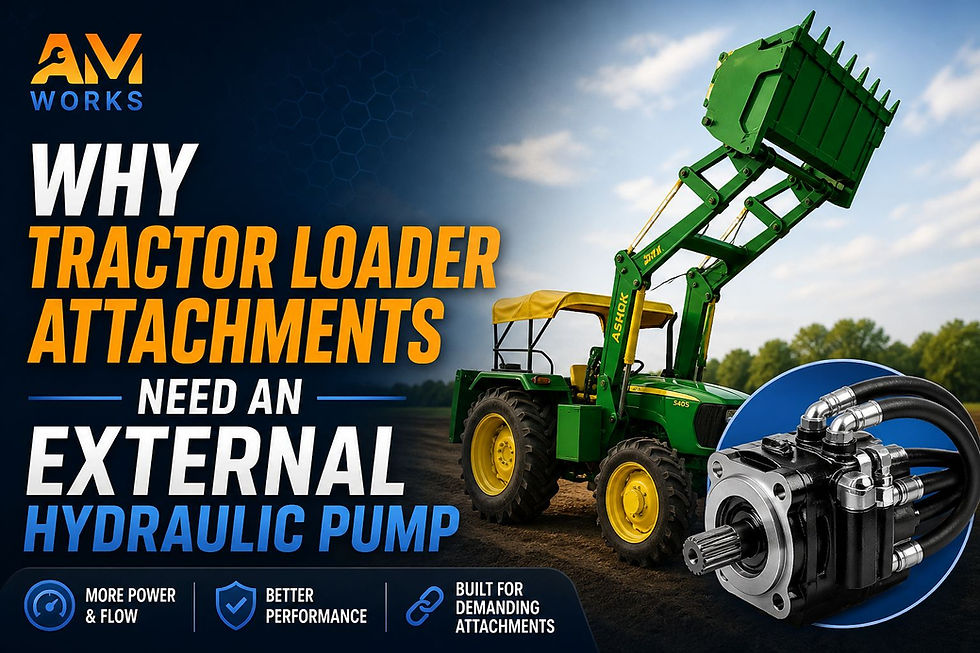
Top Tractor Loader Mistakes Farmers Make That Reduce Productivity & Damage Equipment

Modern tractor loaders have become essential for agriculture, construction support, material handling, silage movement, manure loading, and rural infrastructure work. However, improper operation and poor maintenance practices can significantly reduce machine life, increase hydraulic failures, and lower overall productivity.
Ashok Metal Works (AMW) manufactures heavy-duty tractor loader attachments designed for Indian farming and construction conditions. Their loaders are widely used for material handling, sand loading, silage movement, debris clearance, and commercial agricultural operations.
This guide explains the most common tractor loader mistakes farmers make and how to avoid costly repairs, downtime, and performance loss.
⚙️ 1. Overloading Tractor Loader Attachments Beyond Capacity
One of the most common tractor loader mistakes is lifting material beyond the recommended payload capacity.
Overloading creates excessive stress on:
Hydraulic cylinders
Front axle
Loader arm joints
Pins & bushes
Tractor chassis
Ashok Metal Works loader systems are built for heavy-duty work, but continuous overloading can still reduce component life and increase maintenance costs.
Common Overloading Mistakes in Tractor Loader Operations
Front axle bending
Hydraulic oil overheating
Slow lifting response
Excessive tyre wear
Loader instability
Best Practice
Always match:
Bucket size
Tractor HP
Hydraulic flow
Payload requirement
before operating the loader attachment.
🛠️ 2. Operating Without a Proper Counterweight
Many operators ignore rear ballast or counterweight installation.
This is a major safety and productivity issue.
Without proper balancing:
Rear wheels lose traction
Steering becomes unstable
Tractor rollover risk increases
Front axle damage becomes more likely
Ashok Metal Works tractor loaders are commonly paired with counterweight systems for better stability during heavy lifting operations.
Recommended Solution
Use:
Rear weight box
Heavy rear implement
Proper wheel ballast
especially while handling sand, gravel, soil, or construction material.
🌾 3. Using the Wrong Bucket for the Application
Using a standard bucket for every job reduces efficiency and increases fuel consumption.
Different materials require different bucket configurations.
Common Loader Bucket Applications
Material | Recommended Bucket Type |
Soil & Sand | Standard Bucket |
Silage & Loose Material | High Volume Bucket |
Construction Debris | Heavy Duty Bucket |
Multi-purpose Farm Work | 4-in-1 Bucket |
A properly selected bucket improves:
Loading speed
Fuel efficiency
Hydraulic response
Operator control
Ashok Metal Works offers multiple loader configurations for agriculture and construction applications.
🔧 4. Ignoring Hydraulic Oil Maintenance
Hydraulic failure is one of the biggest causes of tractor loader downtime.
Dirty or degraded hydraulic oil can damage:
Pumps
Valves
Cylinders
Seals
Hydraulic hoses
Ashok Metal Works loader systems use hydraulic lift systems engineered for continuous field operations.
Common Hydraulic Maintenance Mistakes
Delayed oil replacement
Contaminated hydraulic oil
Low oil levels
Ignoring oil leaks
Using incorrect oil grade
Maintenance Recommendation
Check:
Oil levels daily
Hose leakage weekly
Hydraulic temperature during heavy-duty operation
🚜 5. Sharp Turning with a Raised Loader
Driving fast while keeping the bucket fully raised is extremely dangerous.
This increases:
Centre of gravity
Tractor instability
Risk of side overturning
It also places unnecessary stress on:
Loader arms
Front suspension
Hydraulic cylinders
Best Practice
Keep the bucket low while transporting material.
Only raise the loader while:
Dumping
Loading
Positioning material
⚠️ 6. Poor Lubrication of Pins & Bushes
Pins and bushes handle constant movement and heavy pressure.
Lack of greasing causes:
Excessive wear
Noise
Loose joints
Loader arm play
Over time, this reduces loader precision and increases repair expenses.
Recommended Practice
Lubricate:
Loader pivots
Pins
Bushes
Hydraulic joints
at regular operating intervals.
🧱 7. Using a Loader on Unsuitable Tractor HP
Not every tractor is suitable for heavy-duty loader applications.
Undersized tractors face:
Engine strain
Poor lifting performance
Hydraulic inefficiency
Stability issues
Ashok Metal Works manufactures tractor loader attachments compatible with multiple tractor configurations and working conditions.

Always Verify:
Tractor horsepower
Hydraulic compatibility
Front axle strength
Tire configuration
before the loader installation.
🌡️ 8. Continuous Operation Without Cooling Breaks
During summer conditions in India, continuous loader operation can overheat:
Hydraulic oil
Pump systems
Tractor engine
This is common during:
Sand loading
Construction operations
Continuous farm loading work
Best Practice
Allow periodic cooling intervals during long operations.
This improves:
Hydraulic life
Seal durability
Pump performance
📉 9. Delaying Small Repairs
Ignoring small issues often results in major failures later.
Common examples:
Minor oil leakage
Loose hydraulic fittings
Cracked hoses
Bucket pin wear
Early maintenance always costs less than major hydraulic repairs.
🔍 Why Proper Tractor Loader Operation Matters
A properly maintained tractor loader improves:
Productivity
Fuel efficiency
Machine life
Operator safety
Daily output
Ashok Metal Works tractor loaders are designed for rugged Indian agriculture and construction environments with durable hydraulic systems and heavy-duty fabrication.
🚜 Applications of Tractor Loaders
Ashok Metal Works loaders are commonly used for:
Sand loading
Silage handling
Soil movement
Farm waste handling
Gravel loading
Warehouse operations
Construction material movement
📌 Final Thoughts
Most tractor loader failures are caused not by manufacturing defects, but by incorrect operation, poor maintenance, and overloading.
Avoiding these common tractor loader mistakes can:
Increase equipment lifespan
Reduce repair costs
Improve lifting performance
Enhance operator safety
Maximise daily productivity
Ashok Metal Works continues to manufacture heavy-duty tractor loader attachments engineered for Indian farming and construction conditions with durability, stability, and long-term field performance in mind.
📞 Contact Ashok Metal Works (AMW)
📞 +91 94251 49002
📍 Jatrapura, behind Ram Leela Maidan, Vidisha, Madhya Pradesh 464001
🇮🇳 Made in Bharat
📌 FAQ Section
🚜 What is the most common tractor loader mistake?
Overloading the bucket beyond the loader’s lifting capacity is one of the most common mistakes. It increases stress on the hydraulic system and front axle.
⚙️ Why is a counterweight important in a tractor loader ?
Counterweight improves stability, prevents rollover risk, and reduces stress on the tractor’s front axle during heavy lifting.
🛠️ How often should tractor loader hydraulic oil be checked?
Hydraulic oil levels should be checked daily before operation, especially during heavy-duty agricultural or construction work.
🌾 Which bucket is best for agricultural use?
The ideal bucket depends on the application. Standard buckets work well for soil and sand, while 4-in-1 buckets are suitable for multi-purpose agricultural operations.
🔧 How can tractor loader life be increased?
Regular greasing, hydraulic maintenance, proper ballast usage, and avoiding overloading significantly improve tractor loader lifespan.