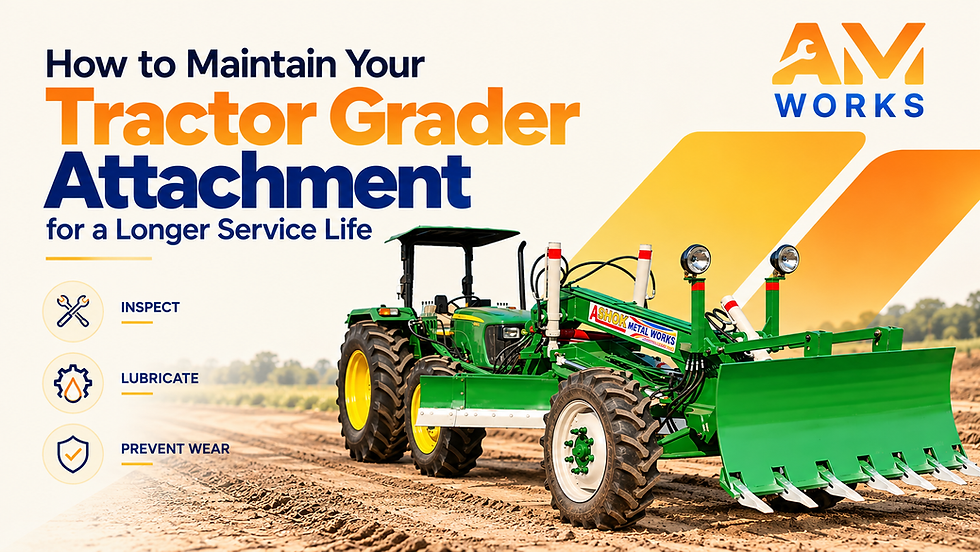
Choosing the Right Tractor HP for Grader Attachments: 50–75 HP Explained

Many road contractors assume that grader attachments demand very high-horsepower tractors. In reality, most rural, semi-urban and secondary road grading projects across India are efficiently completed using tractors in the 50–75 HP range. The key factor is not maximum horsepower, but how well the tractor, grader attachment and configuration are matched.
This guide explains how to select the right tractor HP and drivetrain setup for consistent grader performance in real site conditions.
Reality of Tractor HP Usage in Road Construction
Across PMGSY works, village roads, industrial layouts and maintenance contracts, most grader attachment users operate tractors between 50 and 75 HP. Contractors typically already own 50–60 HP tractors for loading, hauling and general construction tasks. Those handling long, time-bound grading stretches often step up to 65–75 HP to increase daily output.
Ashok Metal Works designs its tractor grader attachments specifically to work efficiently within this 50–75 HP band, allowing contractors to use existing tractors instead of investing in heavier machines.
Can a 50–60 HP Tractor Handle a Grader Attachment?
Yes. A 50–60 HP tractor can handle almost all grader attachment applications, including:
Road levelling and routine maintenance
Gravel and moorum spreading
Shoulder formation
Final surface finishing
The difference compared to higher HP tractors lies mainly in operating speed, not grading capability.
Typical Grading Speed (Approximate)
50–60 HP tractor: ~3–4 km/h
65–75 HP tractor: ~4–6 km/h
Lower HP may require more passes in compacted layers, but grading quality remains achievable.
What Additional Horsepower Actually Provides
Moving from a 50–60 HP tractor to a 65–75 HP tractor offers:
Faster forward grading speed
Reduced time per kilometre
Better momentum in tougher sections such as compacted gravel or WMM
Higher HP improves productivity, not the type of work the grader can perform. Finish quality depends more on blade control, operator skill and attachment geometry than raw engine power.
2WD Tractors and Four-Wheel Grader Configuration
Many contractors operate 2WD tractors. In such cases, Ashok Metal Works’ four-wheel grader configuration provides a practical solution.
This setup:
Replaces the tractor’s original front axle
Uses a purpose-built grader chassis with its own front wheels
Improves weight distribution and blade stability
The tractor remains 2WD, but grading performance improves significantly without upgrading to a factory 4WD tractor.
4WD Tractors as Six-Wheel Graders
When a 4WD tractor is paired with a grader attachment, the combination effectively functions as a six-wheel grader:
Tractor rear wheels
Tractor front drive wheels
Grader attachment wheels
This configuration delivers:
Higher traction with minimal slippage
Consistent grading speed under load
Better performance on slopes, wet soil and uneven terrain
Reduced operator fatigue over long stretches
Ashok Metal Works grader attachments are engineered to support both four-wheel and six-wheel grading setups depending on site conditions.
Fuel Use and Operating Economics
50–60 HP setups: Lower hourly fuel consumption, slower execution
65–75 HP setups: Slightly higher hourly fuel use, faster project completion
For most contractors, overall profitability depends on matching HP to workload, not maximising horsepower.
Conclusion
Choosing the right tractor for a grader attachment is not about buying the biggest engine. It is about selecting the right HP range, traction setup and attachment design for actual site conditions.
For most contractors, tractors between 50 and 75 HP, paired with well-designed grader attachments from Ashok Metal Works, deliver reliable grading quality, balanced fuel economics and higher overall project efficiency.