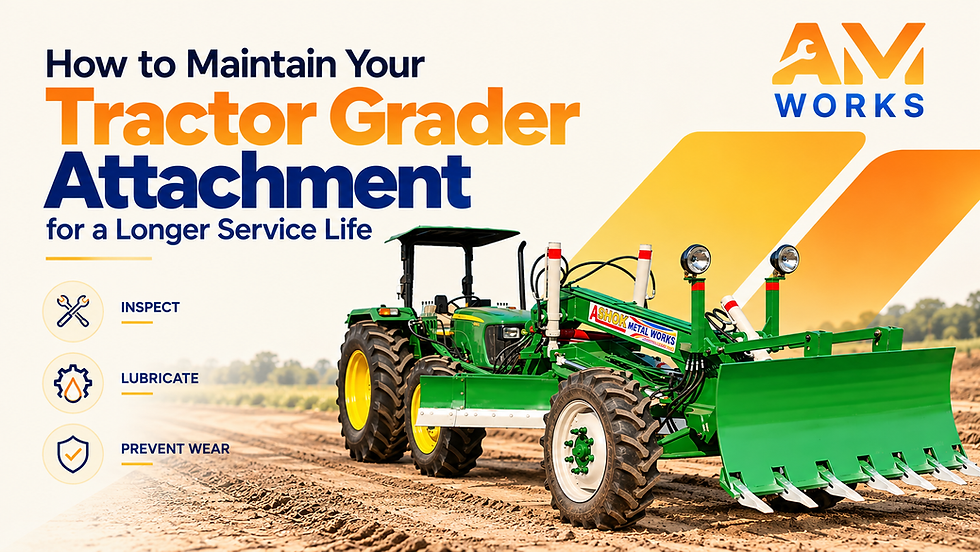
Why Grader Attachment Weight Matters: The Most Overlooked Factor in Road Construction Performance

Road contractors often compare grader attachments based on blade width, hydraulic controls, tractor compatibility, and price. However, one specification has a direct impact on grading quality, productivity, and machine performance:
Grader Attachment Weight.
Whether you’re maintaining rural roads in Madhya Pradesh, constructing PMGSY roads in Uttar Pradesh, or performing land development work in Chhattisgarh and Odisha, the weight of the grader attachment plays a crucial role in determining how efficiently the machine can cut, level, and shape the surface.
⚙️ How Grader Attachment Weight Impacts Road Construction Quality
A grader attachment works by applying downward pressure through its blade to cut and redistribute material. The heavier the attachment, the greater the force applied to the blade without relying solely on hydraulic pressure.
This directly affects:
Blade penetration
Surface levelling quality
Road camber accuracy
Operator productivity
Fuel efficiency
Number of grading passes required

A lightweight grader may ride over compacted surfaces, while a properly weighted grader cuts consistently and maintains grade accuracy.
🚜 How Grader Weight Impacts Road Construction Quality
Better Blade Penetration
Roads that have been compacted by traffic, rainfall, or previous grading operations require sufficient cutting force.
A heavier grader:
✅ Cuts deeper in fewer passes
✅ Removes potholes more effectively
✅ Shapes road shoulders accurately
✅ Handles gravel and WBM roads efficiently
Improved Stability During Operation
One of the biggest challenges during grading is blade chatter or bouncing.
Insufficient attachment weight can cause:
Uneven cuts
Surface ripples
Operator fatigue
Additional rework
A heavier grader remains stable, resulting in a smoother road finish.
More Accurate Camber Formation
Proper road drainage depends on maintaining the correct camber.
A stable grader attachment helps operators achieve:
Consistent cross slopes
Better water runoff
Reduced road deterioration
Improved long-term maintenance performance
This is especially important for PMGSY and Panchayat road projects.
📊 Heavy Grader vs Lightweight Grader Comparison
Parameter | Lightweight Grader | Heavy-Duty Grader |
Blade Penetration | Moderate | Excellent |
Stability | Lower | Higher |
Number of Passes | More | Fewer |
Surface Finish | Average | Superior |
Productivity | Moderate | High |
Fuel Efficiency per Job | Lower | Higher |
Contractor Profitability | Lower | Higher |
While a lightweight grader may appear easier to pull, heavy-duty graders generally complete projects faster and with better accuracy.
🛠️ Why Contractors Often Ignore Weight During Purchase
Many buyers focus primarily on:
Purchase price
Blade width
Hydraulic cylinders
Tractor compatibility
Unfortunately, attachment weight is often overlooked because it is not immediately visible in brochures.
The result:
Reduced grading efficiency
Higher operating costs
More machine hours
Increased fuel consumption
For contractors working on road maintenance tenders, these factors directly affect project profitability.
🌍 Applications Where Grader Weight Makes the Biggest Difference
Rural Road Construction
Village roads often develop potholes and uneven surfaces after monsoons. A heavier grader provides better cutting performance during maintenance operations.
PMGSY Road Projects
Accurate grading and proper drainage are essential to meet project specifications.
Canal & Irrigation Projects
Slope accuracy is critical for water flow management.
Mining & Industrial Roads
Hard surfaces require greater blade pressure for effective grading.
Land Development Projects
Heavier graders perform better when levelling large plots for construction and agriculture.
📦 What Buyers Should Evaluate Beyond Weight
Weight alone does not guarantee performance.
Contractors should evaluate:
Machine Construction
Chassis strength
Structural design
Material thickness
Blade Design
Cutting edge quality
Blade width
Blade adjustment range
Hydraulic System
Cylinder quality
Hose protection
Control precision
Tractor Compatibility
Recommended HP range
Hydraulic flow requirements
Front ballast requirements
🚜 Ashok Metal Works Graders: Engineered for Stability & Performance
Ashok Metal Works has been manufacturing grader attachments since 2001 for contractors, infrastructure companies, government departments, and agricultural customers across India.
Key advantages include:
Key Features
✅ Heavy-duty structural frame
✅ Optimised weight distribution
✅ Hydraulic grading controls
✅ Designed for demanding road applications
✅ Suitable for rural roads, industrial roads, and land development projects
Typical Applications
PMGSY Roads
Panchayat Roads
Canal Construction
Farm Roads
Industrial Sites
Infrastructure Projects
Compatible Tractor Range
49 HP and above (depending on model)
For contractors comparing graders, attachment weight should be considered alongside blade design, hydraulic performance, and overall structural strength.
💡 Final Verdict
When evaluating a grader attachment, weight should never be treated as a secondary specification.
A properly engineered heavy-duty grader delivers:
✔ Better blade penetration
✔ Superior road finish
✔ Higher productivity
✔ Lower operating costs
✔ Greater contractor profitability
For road construction and maintenance projects, the difference between a lightweight grader and a properly weighted grader can determine how quickly a project is completed and how long the finished road lasts.
Choosing the right grader is not just about blade width or price—it’s about selecting a machine designed to perform under real working conditions.
📞 Looking for a Heavy-Duty Tractor Grader?
Ashok Metal Works manufactures tractor grader attachments for road construction, land development, canal projects, and infrastructure applications across India.
📞 +91 9993054606
📍 Jatrapura, Behind Ram Leela Maidan, Vidisha, Madhya Pradesh – 464001
🇮🇳 Made in Bharat
❓ Frequently Asked Questions (FAQ)
What is the ideal grader attachment weight for road construction?
The ideal grader attachment weight depends on the tractor’s horsepower, road conditions, and application. A properly weighted grader provides better blade penetration, stability, and grading accuracy without overloading the tractor.
Why does grader attachment weight affect grading performance?
Grader attachment weight increases downward force on the blade, allowing it to cut compacted surfaces more effectively. This results in fewer grading passes, improved road finish, and higher productivity.
Is a heavier grader attachment always better?
Not necessarily. While additional weight improves cutting performance, the grader must be properly designed and matched to the tractor’s horsepower. Excessive weight can reduce manoeuvrability and strain equipment.
How does grader attachment weight impact fuel consumption?
A properly weighted grader often reduces overall fuel consumption by completing grading tasks in fewer passes. Lightweight graders may require additional passes to achieve the same result.
Does the weight of grader attachments improve road quality?
Yes. Greater attachment stability helps maintain consistent blade contact with the surface, resulting in smoother roads, accurate camber formation, and improved drainage.
What should contractors evaluate besides grader attachment weight?
Contractors should also consider:
Blade width
Hydraulic controls
Frame construction
Tractor compatibility
Service support
Availability of spare parts
Which applications benefit most from heavier grader attachments?
Heavy-duty grader attachments are commonly used for:
Rural road construction
PMGSY road projects
Canal construction
Mining roads
Industrial site development
Farm road maintenance
Does Ashok Metal Works manufacture heavy-duty grader attachments?
Yes. Ashok Metal Works manufactures tractor-mounted grader attachments designed for road construction, land development, canal projects, and infrastructure applications across India.