Can a Tractor Grader Handle Mining and Quarry Haul Roads? Capacity, Limits, and What to Check Before You Buy

Someone on every quarry site eventually asks this question the hard way after buying the wrong machine. A tractor grader costs a fraction of a motor grader and does real work on real haul roads, which is exactly why the question "can it handle our site?" gets asked more than it gets answered honestly. Ashok Metal Works has built tractor grader attachments for 25+ years, across more than 10,000 customers, and the short version is: it depends entirely on which road on your site you're talking about. Here's the long version.
🛣️ What Actually Makes a Mining or Quarry Haul Road Different
A haul road isn't a farm track that happens to be wider. It's built to carry loaded trucks sometimes 30 tons, sometimes well over 100, on a repeating cycle, day after day, often in both directions at once. That means real crown and cross-slope for drainage, enough width for trucks to pass safely, and a surface that gets chewed up fast enough that regrading isn't occasional maintenance; it's a schedule. Dust, loose aggregate, and a base that shifts under heavy axle loads are the normal condition, not the exception.
None of that is a reason to assume you need the biggest machine on the lot. It's a reason to match the equipment to the specific road, not the site as a whole.
⚙️ Where a Tractor Grader Genuinely Fits on a Quarry Site
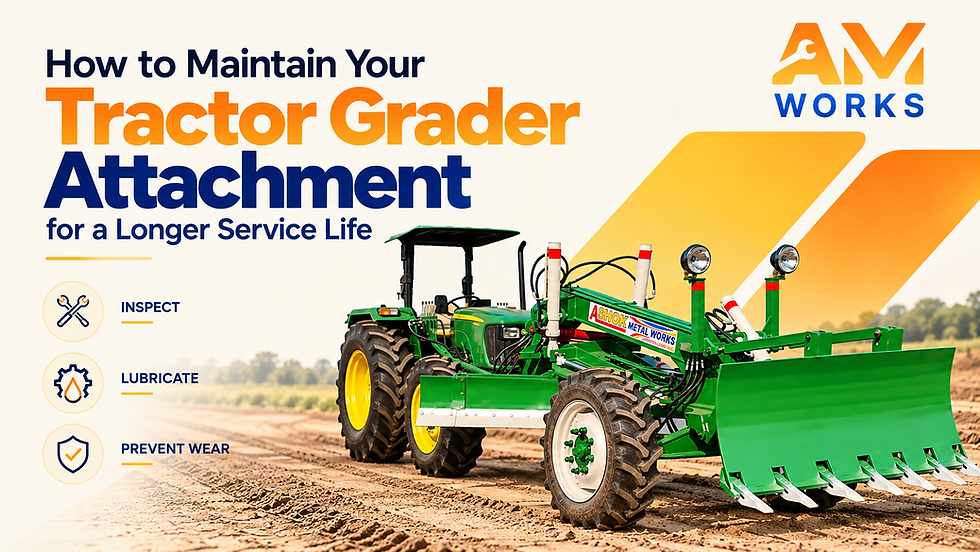
Smaller quarries, perimeter and access roads, internal roads with lighter or less frequent truck traffic, and maintenance grading between a motor grader's major passes this is where a tractor grader earns its keep. It runs off a tractor you probably already own, which means no separate engine, no separate drivetrain, and far fewer things that can fail compared to a motor grader's own engine, transmission, and hydraulic system. That's the real version of the "low-maintenance" argument you'll hear from grader manufacturers, and it holds up: fewer independent systems means fewer independent failure points.
Ashok Metal Works builds its main grader line on a single-pin mount specifically because it gives higher structural strength and better load handling than the double-pin designs used in some lighter setups, which matters more on a quarry's loose, uneven surface than it does on a graded farm road.

📏 Specs That Actually Matter for Grading Haul Roads
Not every spec on a data sheet is equally relevant once you're grading quarry roads instead of farm tracks. Ground clearance and rotation matter more than almost anything else here, because loose aggregate and ruts punish a low-clearance blade fast.
Configuration | Tractor HP | Rotation | Ground Clearance |
Single Pin | 49–110 HP | Up to 45° | — |
Double Pin | 49 HP and above | Up to ~40° | 460 mm |
Four-Wheel | 49 HP and above | Up to 45° | 460 mm, rated for ~70–80 truckloads of material moved per day |
Across the range: a 10-foot (3000 mm) blade, 5°–20° tilt for crown shaping, 5% camber cutting height, and a 1-year hydraulic warranty. The tilt range is what actually builds the cross-slope a haul road needs for water to run off instead of pooling into the kind of ruts that eat tyres.
🚧 Where a Tractor Grader Stops Being Enough
Be honest with yourself here, because this is the mistake that costs money. A primary haul road on a large open-pit operation, wide enough for oversized haul trucks to pass, built for continuous heavy traffic, and requiring a blade that spans most of the road width in one pass, is beyond what a 49–110 HP tractor and a 10-foot blade were designed to do. Dedicated motor graders run at much higher horsepower, use wider blades, and have articulated frames built specifically for that scale and traffic load. This isn't an Ashok Metal Works-published capacity limit; it's the basic physics of matching blade width and push force to the job, and it's worth confirming against your specific road's traffic volume and width rather than guessing either direction.
If you're unsure which side of that line your haul road falls on, that's a five-minute conversation with Ashok Metal Works' team worth having before you commit to either option.
💰 The Cost Side of the Decision
A tractor grader attachment has been quoted starting around ₹4.15 lakh in Ashok Metal Works' own published pricing; confirm current pricing directly, since that figure can shift. A dedicated motor grader runs many times that, and the gap isn't just the purchase price: a motor grader needs its own operator, its own fuel budget, and its own service schedule, separate from anything else on site. For a quarry running secondary or access roads, that's often a cost nobody needs to carry. For a primary haul road on a large operation, it's a cost that's already justified by the road itself.
✅ What to Check Before You Buy for Quarry or Haul Road Work
✅ Measure the actual width of the road you're grading, not the widest road on the site
✅ Count the trucks and their loaded weight; occasional light traffic and continuous heavy traffic aren't the same problem
🔧 Confirm ground clearance against your worst rutting, not your best-graded day
🛠️ Match HP to the configuration, not the other way around. Don't undersize the tractor to fit a grader you've already decided on.
⚠️ If the road in question is your site's primary haul route for loaded trucks, get a motor grader quote alongside the tractor grader quote before deciding
Frequently Asked Questions
Q: Can a tractor grader handle mining and quarry haul roads?
A: It depends on which road. A tractor grader genuinely fits perimeter roads, access roads, smaller quarries, and maintenance grading between major passes. A primary haul road carrying continuous heavy truck traffic on a large operation is typically beyond what a 49–110 HP tractor grader is built for.
Q: What HP tractor do I need for quarry road grading?
A: Ashok Metal Works' tractor grader runs 49–110 HP depending on configuration. Single Pin covers the full range, while Double Pin and Four-Wheel are rated 49 HP and above.
Q: How wide is the blade on a tractor grader attachment?
A: 10 feet (3000 mm) across the standard range.
Q: Why is ground clearance important for quarry roads specifically?
A: Quarry surfaces are loose and uneven, with ruts that form faster than on a maintained farm road. Low ground clearance means the blade or frame catches on terrain a higher-clearance setup would clear.
Q: Is a tractor grader really lower maintenance than a motor grader?
A: Yes, generally. A tractor grader runs off a tractor's existing engine and hydraulics, so there's no separate engine, transmission, or hydraulic system to maintain the way a motor grader requires.
Q: What does a tractor grader attachment cost compared to a motor grader?
A: Ashok Metal Works has published pricing starting around ₹4.15 lakh for the attachment; confirm current figures directly. A dedicated motor grader costs many times that, plus its own dedicated operator and service costs.
Q: What's the warranty on a tractor grader attachment?
A: A 1-year hydraulic warranty is standard across the range.
Q: How do I know if my haul road actually needs a motor grader instead?
A: If it's a primary route carrying continuous heavy, loaded truck traffic and needs a blade spanning most of the road width in one pass, get a motor grader quote alongside any tractor grader quote before deciding.
Connect With Us
📍 Ashok Metal Works, Jatrapura, behind Ram Leela Maidan, Vidisha, Madhya Pradesh 464001, India
📞 +91 9993054606 (call or WhatsApp)
📷 Instagram: @ashokmetalworkspvt.ltd · Facebook: Ashok Metal Works · LinkedIn: Ashok Metal Works Pvt. Ltd. · YouTube: @AshokMetalWorks_Pvt.Ltd.
Not sure which side of the line your haul roads fall on? Send the team your road width and traffic volume 25+ years of fitting graders to real sites means they can usually tell you in a few minutes, not a few site visits.